Get a Free Cooling System Assessment — Request Your Custom Quote Today

MideaCool Sustainability & Environmental Commitment

Engineering a path toward low-carbon cooling through natural refrigerants, energy efficiency innovation, and responsible manufacturing.

Our Sustainability Vision

The refrigeration industry accounts for a significant share of global energy consumption and greenhouse gas emissions. At MideaCool, we recognize our responsibility to lead the transition toward sustainable cooling.

Our sustainability strategy rests on three pillars: transitioning to low-GWP natural refrigerants, maximizing energy efficiency across our product portfolio, and reducing the environmental footprint of our manufacturing operations.

We are committed to full compliance with the EU F-Gas Regulation, EPA SNAP requirements, and the Kigali Amendment phase-down schedule — not as a regulatory obligation, but as a core engineering principle.
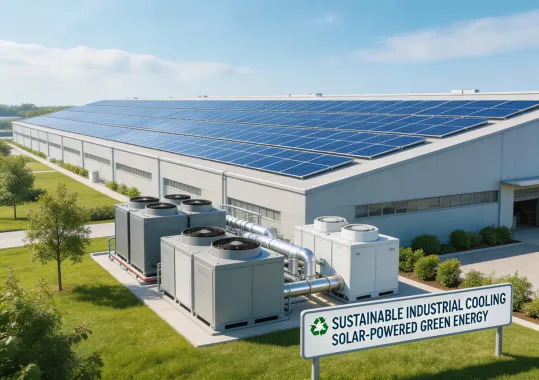
MideaCool Sustainable Manufacturing

Refrigerant Transition Roadmap

From high-GWP HFCs to natural and low-GWP alternatives

R-290 (Propane)

GWP = 3. Our compact scroll and screw chiller lines now offer R-290 variants for cooling capacities up to 200 kW. Ideal for commercial buildings and food processing where charge limits permit.

75% of eligible product range converted

R-744 (CO2)

GWP = 1. Transcritical CO2 systems for cold storage and supermarket refrigeration. Our R-744 condensing units deliver reliable performance even in warm-climate regions above 35°C ambient.

50% of cold storage range available in R-744

R-1234ze (HFO)

GWP = 7. Low-GWP synthetic alternative for large centrifugal chillers where natural refrigerant charge limits are impractical. Drop-in compatible with our 500-2,000 kW centrifugal platform.

90% of centrifugal range R-1234ze ready

Energy Efficiency Targets

Measurable progress toward lower operating energy consumption

Variable-Speed Compressor Adoption

Inverter-driven compressors reduce energy consumption by 25-40% at part-load conditions compared to fixed-speed equivalents. By 2026, 85% of our chiller product lines will feature variable-speed as standard.

IPLV Optimization Program

Our engineering team targets IPLV ratings below 0.50 kW/TR across the water-cooled screw chiller range. Ongoing heat exchanger surface optimization and compressor profiling contribute to incremental annual efficiency gains.

Manufacturing Carbon Footprint

We have reduced factory energy consumption per unit produced by 18% since 2019 through LED lighting upgrades, compressor air leak reduction programs, and rooftop solar installations at our Foshan headquarters.

ISO 14001 Environmental Management

All three manufacturing facilities are ISO 14001 certified. Our environmental management system covers waste reduction, water recycling, refrigerant recovery during testing, and supply chain sustainability audits.

Refrigerant Selection: Natural vs. Synthetic Low-GWP Pathways

The industry remains divided on the optimal transition path from high-GWP HFCs. Both approaches carry distinct trade-offs that facility engineers must evaluate.

Natural Refrigerants (R-290, R-717, R-744)

Zero or near-zero GWP with proven long-term sustainability and no patent dependencies. CO2 transcritical systems are increasingly viable even in warmer climates above 35°C. Operating costs at scale are typically lower due to commodity-priced refrigerant supply.

Key limitation: Flammability (R-290) and toxicity (R-717) impose charge limits and require safety-rated machine rooms. R-744 systems operate at pressures up to 120 bar, demanding heavier-gauge piping and specialized components.

Synthetic Low-GWP HFOs (R-1234yf, R-1234ze)

Drop-in compatible with much existing HFC infrastructure, reducing retrofit costs by 40-60% compared to natural refrigerant conversions. Lower flammability risk (A2L classification) simplifies permitting and does not require safety-rated machine rooms.

Key limitation: Higher refrigerant cost due to patent protection (expiring 2030-2035). GWP of 1-7 is low but not zero. Atmospheric decomposition produces trifluoroacetic acid (TFA), whose long-term environmental impact remains under scientific review.

MideaCool offers both pathways. Our application engineers help each client evaluate charge limits, safety requirements, lifecycle cost, and regional regulatory timelines to select the most appropriate refrigerant platform for their specific installation.

Chiller Type Selection: Air-Cooled vs. Water-Cooled

Total cost of ownership depends on climate, water availability, load profile, and facility constraints

Selection Dimension Air-Cooled Chillers Water-Cooled Chillers
Energy Efficiency (COP) 2.8 – 3.5 typical 5.0 – 6.0 typical
Installation Cost Lower — no cooling tower, condenser water piping, or water treatment Higher — requires cooling tower, pumps, water treatment, and basin
Water Consumption Zero 3–5 L per kWh of rejected heat (evaporative losses)
Equipment Lifespan 15–20 years typical 20–30 years typical
Preferred Applications Small/medium facilities (<500 TR), water-scarce regions, rooftop installs Large facilities (>500 TR), data centers, 24/7 process cooling

Neither type is universally superior. A 15-year lifecycle cost analysis considering local energy rates, water costs, and maintenance requirements is the most reliable decision framework.

Explore Our Low-GWP Chiller Range

Ready to future-proof your cooling infrastructure? Our engineers can help you evaluate natural refrigerant options for your application.

Request a Sustainability Consultation